
Understanding Break-In Oil: What Makes It Unique?
When it comes to engine care, using the right oil during the break-in period is crucial for ensuring long-term performance and durability. But what exactly makes break-in oil different from regular motor oil? In this article, we’ll explore the key characteristics that define break-in oil and why it’s an essential component in the early stages of your engine’s life.
The Role of Detergent Levels in Break-In Oil
One of the most important aspects of break-in oil is its detergent level. Detergents in motor oil are designed to clean and prevent deposits from forming on engine parts. While this is beneficial in regular motor oils, break-in oils are formulated with a lower level of detergents. This is intentional, as high detergent levels can hinder the proper bedding-in of new engine components.
However, it’s important to note that break-in oil isn’t non-detergent; it simply contains a reduced amount. This lower detergent level ensures that the oil can clean sufficiently without interfering with the necessary wear-in process of new parts.
High Levels of Zinc and Phosphorus for Anti-Wear Protection
Another defining feature of break-in oil is its high concentration of zinc and phosphorus, often referred to as ZDP (Zinc Dialkyl Dithiophosphate). These elements play a crucial role in providing anti-wear protection, especially during the initial operation of a new engine.
In break-in oil, the levels of zinc and phosphorus are significantly higher than in standard motor oils. For example, a typical break-in oil may contain around 2,990 parts per million (ppm) of phosphorus and 2,713 ppm of zinc, which is roughly triple the amount found in regular passenger car motor oil. This robust anti-wear package is vital for protecting the engine during the critical break-in stage, where the risk of wear is highest.
The Absence of Friction Modifiers
Friction modifiers are common in many modern motor oils, as they help improve fuel economy and reduce friction between moving parts. However, these modifiers are deliberately excluded from break-in oil. The reason is simple: during the break-in period, a certain amount of controlled friction is necessary to allow the engine components to properly seat and form a good wear pattern. The absence of friction modifiers ensures that the necessary break-in wear can occur without interference.
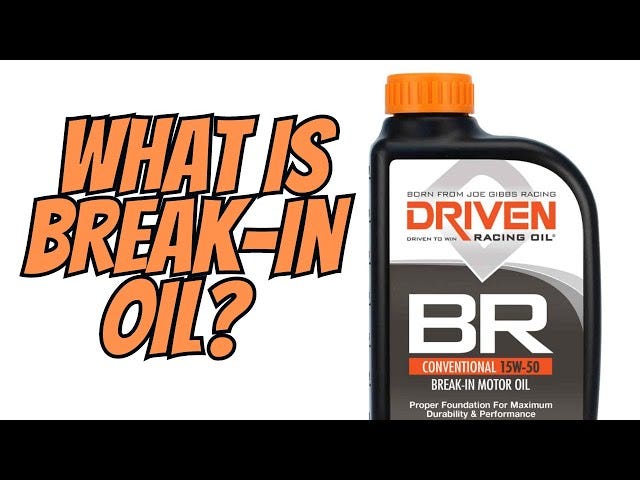
A Closer Look at Driven BR Oil: A Pioneering Break-In Oil
To better understand the characteristics of break-in oil, let’s examine one of the earliest and most popular break-in oils on the market: Driven BR Oil. Driven BR conventional break-in oil is formulated with a viscosity of 15W-50, which falls within the required range for effective lubrication. It’s a mineral-based oil, as indicated by its oxidation value of 3.7, confirming it’s non-synthetic.
Driven Racing Oils offers a large selection of mono-grade and multi-grade break-in oils in a wide range of viscosities, including:
- Driven BR30 5w30 Break-In Oil
- Driven BR40 10W-40 Break-In Oil
- Driven BR50 15w50 Break-In Oil
- Driven GP-1 30W Break-In Oil
Driven BR Oil exemplifies the essential traits of break-in oil: it has a low detergent level (366 ppm of calcium detergent) and a high anti-wear additive concentration. These attributes, combined with the absence of friction modifiers and a small amount of silicon as an anti-foaming agent, make it an ideal choice for the break-in period of an engine.
Conclusion: The Importance of the Right Additive Package
What truly defines a break-in oil is its additive package, rather than its base oil or viscosity. A proper break-in oil is characterized by a balanced formulation: low detergent levels to prevent over-cleaning, high levels of zinc and phosphorus for superior anti-wear protection, and no friction modifiers to allow for controlled break-in wear.
Using the right break-in oil, like Driven BR Oil, during the initial hours of your engine’s life can make a significant difference in its long-term performance and reliability. By understanding these key elements, you can ensure that your engine gets the best start possible.