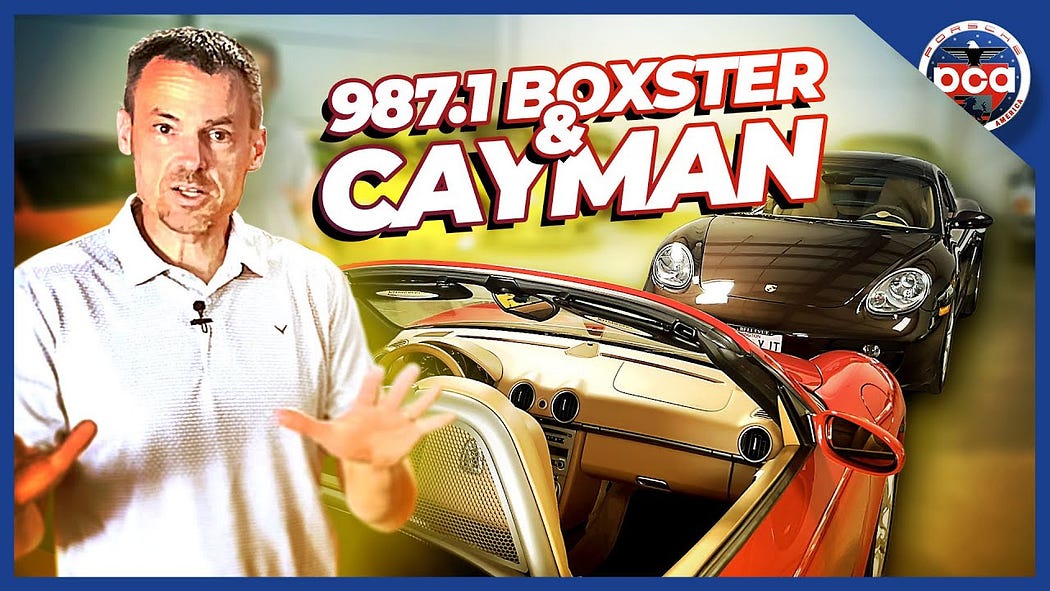
Everything you need to know about Porsche 987.1 Boxster and Cayman models
Porsche 987 Boxster and Cayman Buyer’s Guide: Model Differences, Common Problems, and What to Look For
The Porsche 987, produced from 2005 to 2008 (987.1), includes both Boxster and Cayman variants and represents a significant evolution over the 986 platform. Available in Base and S models, with several special editions in 2008, the 987 offers one of the most rewarding driving experiences of any modern Porsche. With high-quality engineering and timeless styling, it remains a compelling choice for enthusiasts — provided buyers are aware of key technical considerations.
Engine and Model Overview
- Base Models (2005–2008)
- 2.7L flat-six (240–245 hp)
- Typically come with black brake calipers and a single exhaust outlet
- Most were equipped with a 5-speed manual, though a 6-speed was available via the Sport Package
- S Models (2005–2008)
- 3.2L (280 hp) in 2005–2006, upgraded to 3.4L (295 hp) from 2007–2008
- Identified by red brake calipers and dual exhaust outlets
- Cayman (introduced 2006)
- First fixed-roof mid-engine Porsche
- Initially launched only as a Cayman S, with the base Cayman following in 2007
- Transmission Options
- 5-speed and 6-speed manuals
- Tiptronic automatic for all model years
- The more advanced PDK gearbox wasn’t introduced until the 987.2 in 2009
Year-to-Year Differences
- 2005: First year for 987 Boxster; retains the M96 engine in early builds with serviceable IMS bearing
- 2006: Cayman S introduced; fixed silver splitters standard; power increased in later Boxsters
- 2007: Base Cayman introduced; all models receive updated powertrains
- 2008: Final year of 987.1; several special editions produced; introduction of exclusive options and colors
Special Editions (2008 Only)
Porsche produced five special editions in 2008, including:
- Boxster RS60 Spyder: GT Silver with Carrera Red leather, 303 hp, SportDesign aero package
- Boxster Limited Edition (Orange): Black accents, orange paint, sport exhaust
- Boxster Design Edition 2: White with grey striping, sport exhaust, 303 hp
- Cayman Design Edition 1: Black with Porsche Design gauges and accessories
- Cayman Sport: 303 hp, sport seats, and unique color options including GT3 green and orange
Key Visual Identifiers
- Exhaust Tips: Base models have a single outlet; S models have dual outlets
- Brake Calipers: Black for base models, red for S models
- Gauge Colors: Black gauges in base models, silver in S
- Optional Equipment: Wide variation in interior finishes, seat types, and wheels due to Porsche’s extensive option list
IMS Bearing: What You Need to Know
The Intermediate Shaft (IMS) bearing is one of the most discussed concerns with Porsche M96 and M97 engines.
IMS Bearing Variants on 987 Models
- Early 2005 Boxsters may still have the M96 engine with a serviceable IMS bearing
- Late 2005 through 2008 987 models feature the larger non-serviceable IMS bearing, which cannot be removed or replaced without full engine disassembly
- 2009 and later 987.2 models eliminated the intermediate shaft completely, so no worries there.
IMS Bearing Failure Risk
- While the 2006–2008 non-serviceable bearing has a much lower failure rate, it’s not zero,
- Preventative maintenance includes removal of the bearing’s grease seal to allow for better oil splash lubrication
Learn more about IMS bearings and risk mitigation:
2006–08 Porsche IMS Bearing Guide
Bore Scoring: Detection and Prevention
Bore scoring is a form of cylinder wall damage that can lead to oil consumption, piston slap, and eventually engine failure. It primarily affects:
- 3.4L engines (Boxster S and Cayman S)
- Base models (2.7L) and pre-2007 Boxster S models (3.2L) are less prone to the issue
Detection
- Borescope inspection through spark plug holes or sump
- Used oil analysis to detect elevated levels of aluminum and silicon
Prevention Tips
- Use premium synthetic oil, such as Driven DT40, changed every 6 months or 5,000 miles
- Avoid prolonged idling or stop-and-go driving on cold engines
- Maintain proper fueling and address vacuum leaks to avoid over-fueling conditions
- Use fuel system cleaners with PEA (polyetheramine), like Driven Injector Defender, to reduce carbon buildup
Learn more about bore scoring:
What Causes Porsche Bore Scoring?
What to Check When Buying a Porsche 987
When inspecting a 987, check for:
- Front bumper and undertray damage from scrapes
- Rust on suspension fasteners or wheel bolts
- Missing brake duct air guides or splash shields
- Leaks from rear main seal (RMS), transmission, or valve covers
- Signs of prior accident damage or poorly reassembled panels
- Age and condition of tires (check DOT date codes)
- Presence of two keys, wheel lock tool, and original manuals/tool kit
Also inspect the sump plate and oil filter for metallic debris, bore scope the cylinders for scoring on S models with the 3.4 liter engine, and verify that the car has a clean oil analysis report, if available.
Conclusion: Why the 987 Remains a Great Buy
The Porsche 987 Boxster and Cayman offer exceptional performance, balance, and style. With a wide range of configurations, rare colors, and special editions, there’s truly a 987 for every enthusiast. While concerns about IMS bearing failure and bore scoring are valid, they can largely be addressed — or avoided altogether — with proper preventative maintenance and informed purchasing decisions.
For expert insights, rebuild options, and preventative upgrades for Boxster and Cayman models, visit LNEngineering.com today.
LN Engineering is a proud sponsor of Porsche Club of America and Tech Tactics.